Swiss glaciers lose 5.5% of volume in a year
Glacier Monitoring Switzerland said the loss was the second-largest on record after 2022, driven by a winter with little snow and heatwaves that ran from May to September.
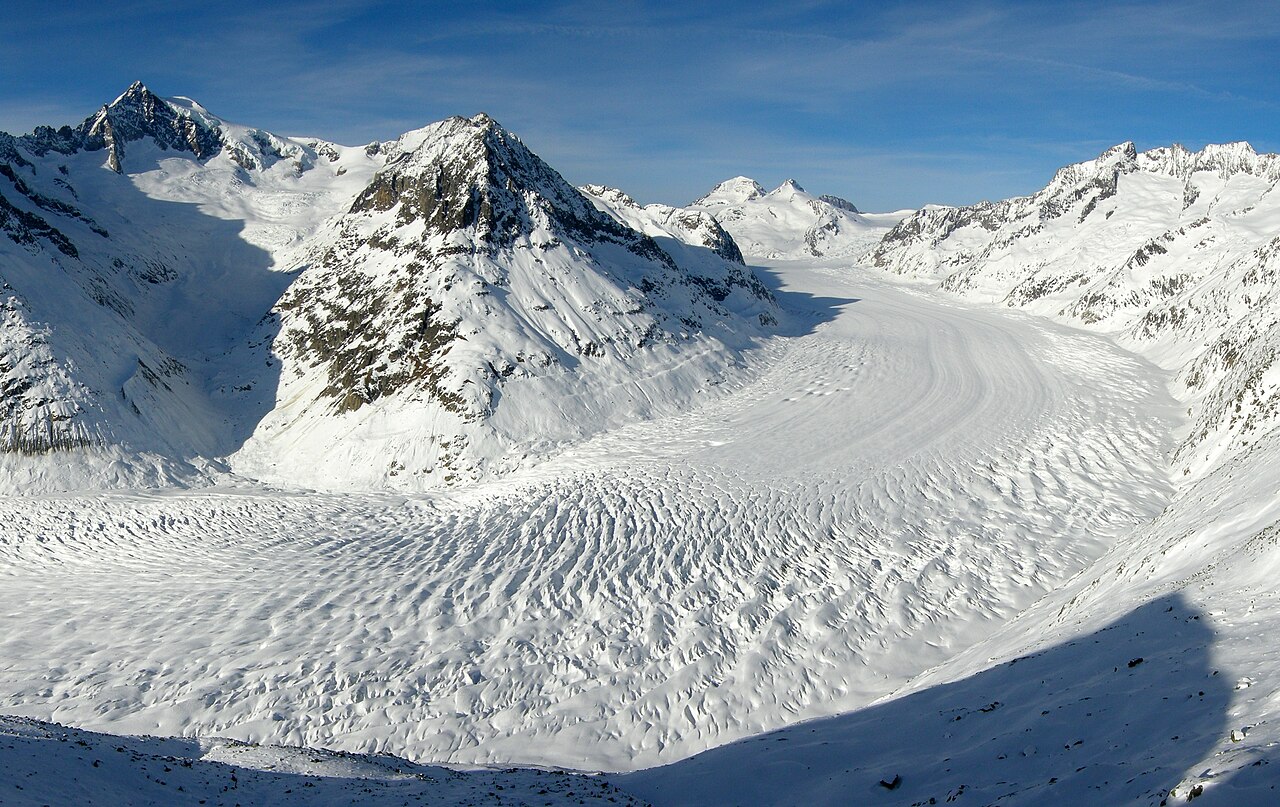
Swiss glaciers lost 5.5% of their remaining ice volume in the year to September 2026, the second-largest annual loss on record, according to Glacier Monitoring Switzerland (GLAMOS).
GLAMOS, which measures the ice loss on 23 glaciers across the Swiss Alps each September, said the average mass balance was minus 2.9 metres of water equivalent for the hydrological year.
Only 2022, when Swiss glaciers lost 6% of their volume, was worse, the monitoring network said.
Between 2022 and 2026, melt rates have been more than twice as high as in any previous five-year period on record, and Swiss ice volume has shrunk by almost 20% since 2021, according to GLAMOS.
The network said this year’s loss followed a winter with very little snow, particularly in the eastern and southern Alps, followed by long and intense heatwaves between May and September.
Matthias Huss, who heads GLAMOS, described the state of the ice fields after the summer to the Associated Press.
“They are completely devoid of ice. It’s a moon landscape that is dry and dead,” Huss said.
Huss said alpine plants are now taking root on ground that was covered by metres of glacial ice until recently.
GLAMOS and the Swiss Academy of Sciences said in a joint statement that “Alpine glaciers have no chance of surviving in the long term under such conditions.”
Huss added that the warming behind the melt was not in dispute.
“The warming that we are experiencing now can be attributed 100 per cent to anthropogenic climate change. It’s as simple as that,” Huss said.
Switzerland’s two largest glaciers, the Aletsch and the Rhône, were among those recording some of their biggest losses, GLAMOS said.
Glaciers act as water reservoirs for much of western Europe, storing winter snow and releasing it gradually through the spring and summer.
Scientists estimate that Swiss glaciers released about 2.2 trillion litres of meltwater between July and September this year.
That meltwater helped ease water shortages during the summer, but it drew down a frozen reserve that smaller glaciers may not be able to replenish, according to GLAMOS.
Low river levels linked to the reduced meltwater halted freight traffic on the Rhine and the Danube over the summer and forced the temporary shutdown of nuclear power stations that depend on river water for cooling.
Around 1,200 smaller Swiss glaciers have disappeared over the past 50 years, GLAMOS said.
Melting glaciers and thawing permafrost can also destabilise mountain slopes, raising the risk of landslides.
In 2025, the Swiss village of Blatten was destroyed after a glacier collapse buried it under about 9 million cubic metres of ice, rock and mud.
If current rates of warming continue, GLAMOS said, Switzerland’s glaciers are on course to disappear entirely by the end of the century.