Neanderthal wooden spears found at rock shelter in Spain
The objects survive only as imprints and charred remains in travertine, and the authors say some of their uses are uncertain.
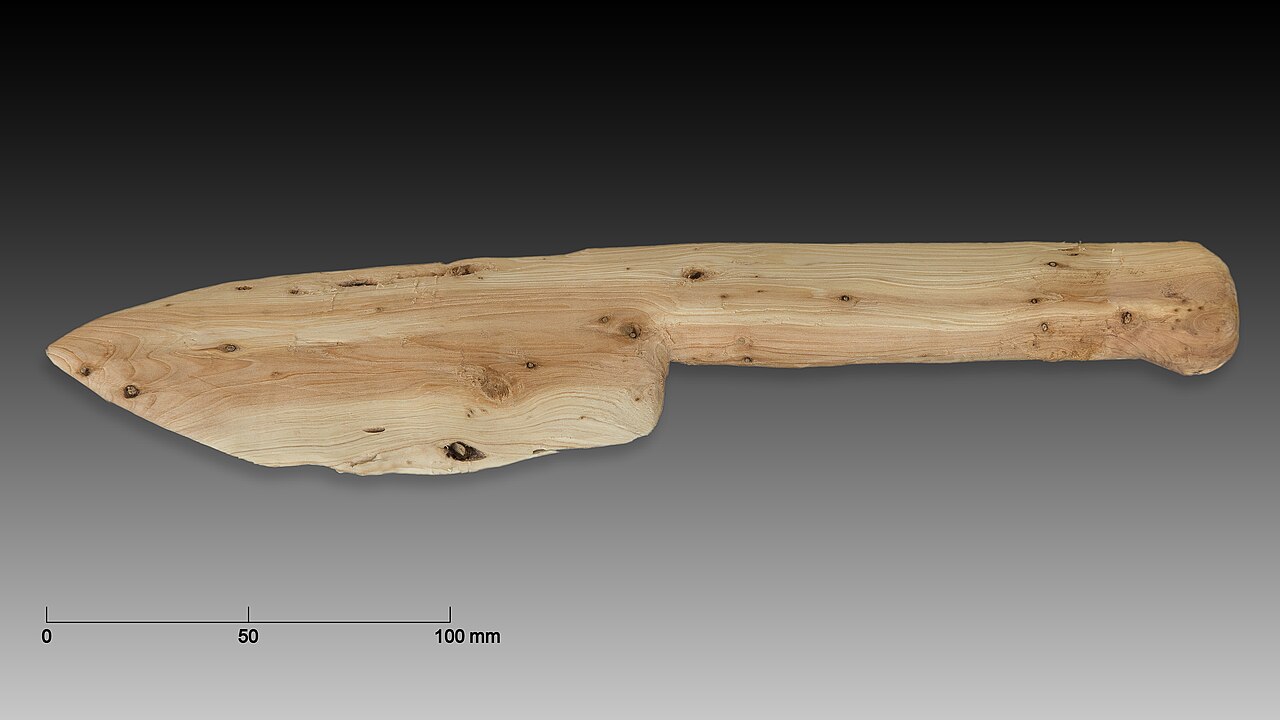
Neanderthals at a rock shelter near Barcelona in Spain made or used 13 wooden objects, among them two spears and a club-like implement, according to a study in Science Advances.
The paper’s first-listed author is Palmira Saladié of the Catalan Institute of Human Paleoecology and Social Evolution (IPHES-CERCA) and Rovira i Virgili University. The team documented 597 wooden imprints and charred wood remains from 16 archaeological levels at Abric Romaní in Capellades. The levels date from about 62,000 to 40,000 years ago.
The wood itself has long since rotted away. As calcium carbonate formed travertine rock around plant material, the wood decayed and left hollow imprints that copy its shape, in some cases down to cellular detail. Most of the 597 specimens are trunks, branches, twigs, roots and firewood, the paper says, and Scots pine was the main fuel burned in the hearths.
The two spears came from level R. One, an imprint 245 centimetres long, can be consistent with a thrusting spear, the authors write. The other is 199 centimetres long and tapers to a point 0.6cm across. Three red deer skulls with antlers were deposited in an area that included the longer spear, and the authors say the antlers suggest the animals were probably hunted in autumn or winter.
Wooden spears from the Palaeolithic have been documented before, at Clacton-on-Sea in England and at Lehringen and Schöningen in Germany. The authors say the specimen from level R resembles some of the German finds in general dimensions and shape, but caution that several of those objects are incomplete or deformed.
The club-like object, from level P, was made from a single piece of wood, with a handle 16 centimetres long and a pointed head 14.2cm high. The authors write that “no similar parallel is known in the prehistoric record of the Old World”. They say its shape is more consistent with a percussive implement than with a tool for systematic soil displacement, though occasional use in digging-related tasks cannot be entirely excluded.
The other finds include four charred bark trays, a tripod-like arrangement of crossed poles above a hearth and several pointed sticks. A branch-free pole 510 centimetres long lay among five hearths in the innermost part of the shelter. The authors suggest it was possibly part of a windbreak or small hut-like shelter, while acknowledging current debates about how Middle Palaeolithic buildings are identified. They also note the difficulty of telling intentionally modified bark containers from bark that detached naturally.
The authors write that the variability in the woodworking “reflects a flexible technological system supported by detailed technological knowledge and adaptive capacities”. They describe their analyses as primarily descriptive and comparative, with functional interpretations proposed cautiously.