Two teams build the first operating nuclear clocks
They do not yet match the best atomic clocks, but the technology could one day rival them and probe physics beyond the standard model.
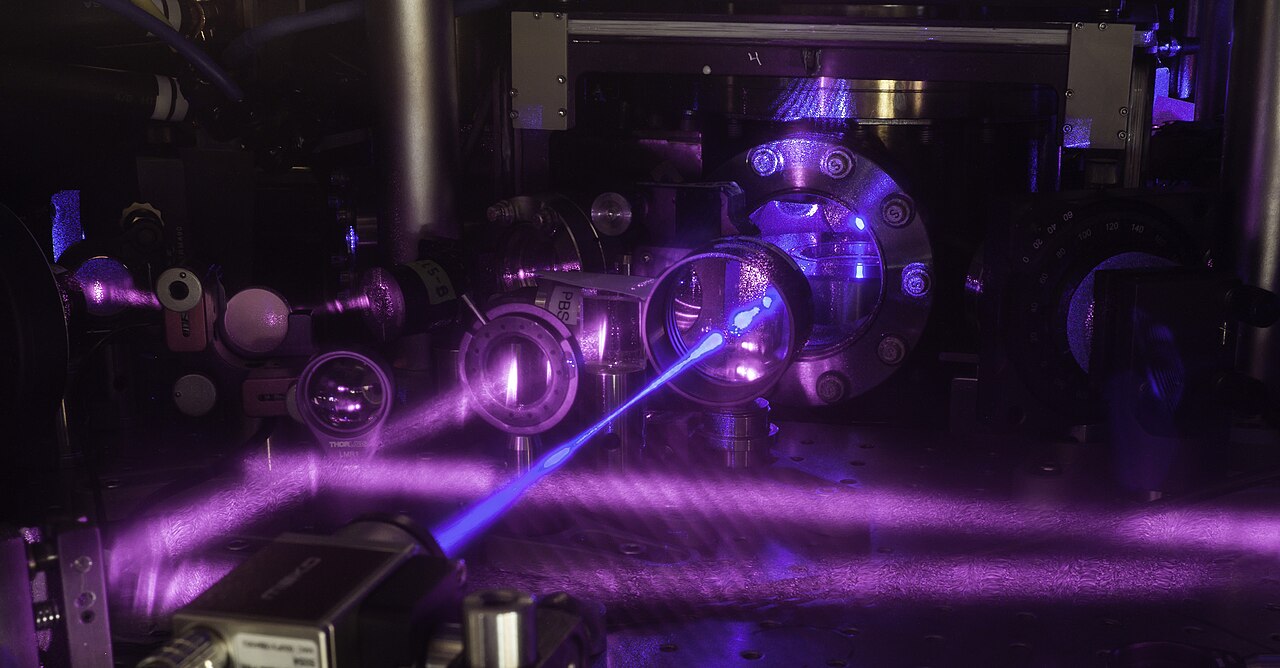
Two research teams, one in Vienna and one in China, have built the first operating nuclear clocks, which keep time with a transition in an atom’s nucleus rather than in its electrons.
Both studies appeared in the journal Nature on 7 October 2026. One was led by Thorsten Schumm of the Vienna University of Technology (TU Wien) and Ekkehard Peik of PTB, the German National Metrology Institute; the other by Shiqian Ding of Tsinghua University in China.
Optical atomic clocks tick at a rate set by a transition between an atom’s electron energy levels. A nuclear clock uses a transition between quantum states of the nucleus, which is small and partly shielded by surrounding electrons, so it can be less susceptible to outside disturbances, Physics magazine explained.
Thorium-229 is a uniquely practical exception: its first excited nuclear state lies just 8.4 electron volts above the ground state. That matches light with a wavelength near 148 nanometres, which purpose-built lasers can reach; most other nuclear transitions need X-ray or gamma-ray photons.
The Vienna clock holds thorium-229 nuclei in a millimetre-sized calcium fluoride crystal at room temperature, according to the Nature paper. A laser excites the nuclei, and when its frequency drifts the crystal absorbs less light, which triggers an automatic correction, TU Wien said in a news release.
The system remained stable for more than 24 hours without intervention. Over a day its precision corresponds to an error of roughly one second in 30 million years, the university said.
“This is not yet at the level of the world’s best optical atomic clocks, but for a first prototype it is a fantastic result,” Schumm said. Physics magazine said the best optical atomic clocks, by comparison, would gain or lose only one second over tens of billions of years.
The two experiments traded laser power against thorium concentration. The Vienna group used a crystal with a relatively high concentration of thorium-229 but a low-power laser; the Tsinghua group, with limited access to thorium-229, used a lower concentration and built a much more powerful laser.
The Vienna team also compared its clock with a ytterbium-ion clock in a search for ultralight dark matter. It found no variation in the nuclear transition on timescales up to one day, and its limits compete with the best atomic clocks on dark matter coupling to photons.
Davide Calonico, scientific director of Italy’s National Institute of Metrological Research, who was not involved, called the results a major metrological milestone and said the clocks already offer greater frequency stability than “many clocks of comparable complexity”.
“The nuclear clock opens a genuinely novel window to physics beyond the standard model,” said Elina Fuchs of DESY and Leibniz University Hannover.