Astronomers find possible ‘phoenix planet’ born of a dead star
A faint brightness signal repeating every 4.4 days in NASA’s TESS data is consistent with a Jupiter-sized gas giant, but the planet remains a candidate.
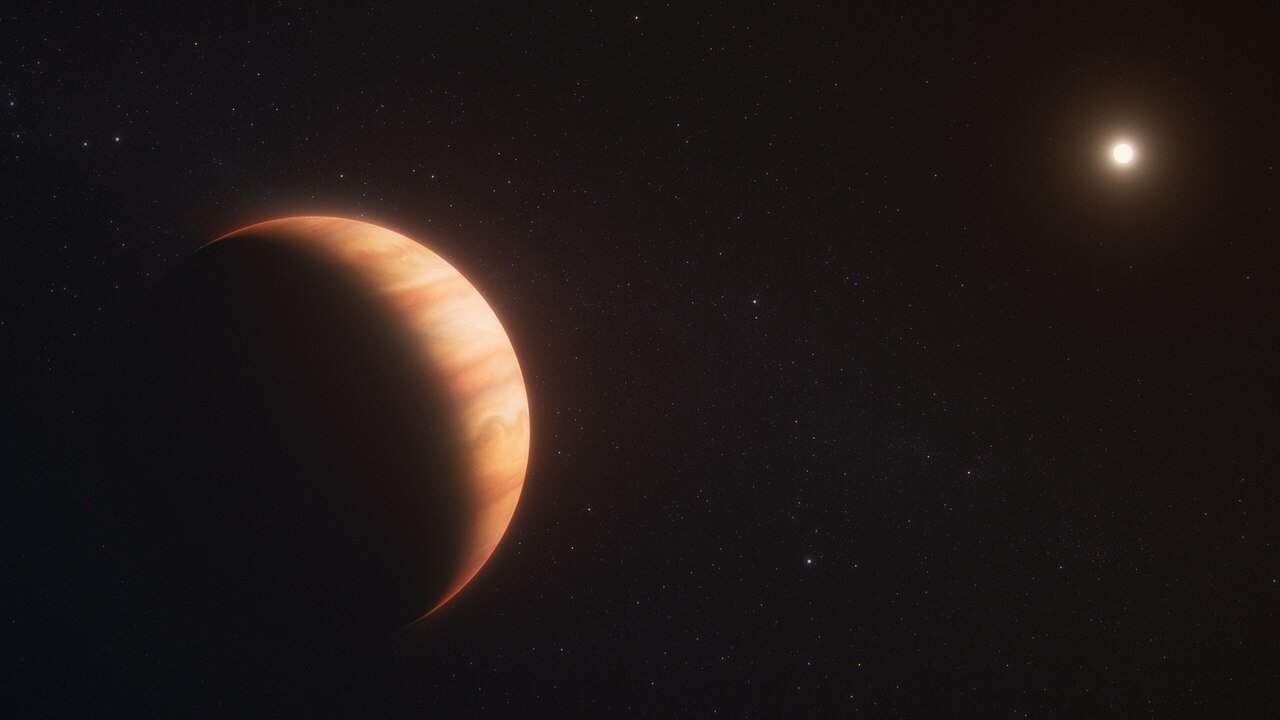
Astronomers have found what appears to be a planet built from the material a dying star threw off, now circling the dead core the star left behind, the University of Warwick said.
The university’s news release calls it “the phoenix planet”, a world “reborn from its star’s ashes”. The star is HS 0209+0832, a white dwarf, the collapsed core left behind when a star runs out of fuel. The study, led by Warwick, was published on 5 October 2026 in Nature Astronomy.
White dwarfs pull in material from nearby planets, which usually shows up in their atmospheres as rock-forming elements such as silicon and iron. The atmosphere of HS 0209+0832 holds unusually heavy elements including zinc, copper and niobium, found at levels over 1,000 times higher than the Sun’s. Niobium has not been found in a white dwarf before.
Dr Nicholas Stone, of the Department of Astronomy at the University of Wisconsin-Madison, said the pattern of elements was a telltale sign of the “s-process”, a nuclear reaction that builds heavy elements inside dying stars. “It’s a chemical signature no ordinary, ‘first-generation’ planet should carry, which told us that this new planet was something different.”
The team’s most likely explanation is that the white dwarf is feeding off a newly formed, second-generation giant planet that condensed out of a new disc of material formed during the star’s death. That disc was made from the star’s own expelled material, so it would be rich in the heavy elements now showing up in the white dwarf’s atmosphere.
Data from NASA’s TESS satellite showed a faint, regular brightness signal repeating every 4.4 days, which is consistent with a Jupiter-sized gas giant tidally locked in a tight orbit. At that distance the planet’s outer atmosphere is expected to be boiling away under intense radiation, with the escaping material raining down onto the white dwarf’s surface and producing the unusual chemical signature. The paper offers a second reading of the signal: a transiting cometary tail of an evaporating gas giant.
Jamie Williams, the study’s first author and a PhD student in Warwick’s Department of Physics, said forming the disc is “not easy”, which helps explain why such planets are so rare. A single, isolated star sheds mass in a roughly symmetrical way, Williams said, so HS 0209+0832 likely needed a companion star that pulled the ejected material back into orbit.
If confirmed, HS 0209+0832 would be the first white dwarf found to host a second-generation planet. The university says the same chemical signature could now be used to look for similar worlds around other dead stars.
Professor Boris Gänsicke, of Warwick’s Department of Physics, said: “Finding this one example raises the question of how many more might be out there and might our own Solar System host a second-generation planet formed from the ashes of our Sun.”