Blue skies and red sunsets have the same cause
Violet light is scattered even more than blue, the Met Office says, but human eyes are more sensitive to blue and sunlight contains less violet to begin with.
Blue skies and red sunsets have the same cause, the scattering of sunlight by the atmosphere, the Met Office says.
Sunlight looks white but is made up of many colours, each with a different wavelength. Red light has the longest wavelength, while blue and violet light have much shorter ones.
When sunlight enters Earth’s atmosphere it collides with tiny gas molecules, mainly nitrogen and oxygen. These are much smaller than the wavelength of visible light, so they scatter shorter wavelengths much more than longer ones, in a process called Rayleigh scattering.
Why not purple?
Violet light is scattered more strongly than blue, yet the sky does not look purple. Eyes are more sensitive to blue, and there is less violet in sunlight to start with.
The blue looks most vibrant overhead and paler near the horizon. Light from the horizon passes through more atmosphere and is scattered and re-scattered on the way, which mixes in more white light and makes the blue less intense. NASA’s Space Place gives a similar account and adds that the surface of Earth also reflects and scatters the light.
What changes at sunset
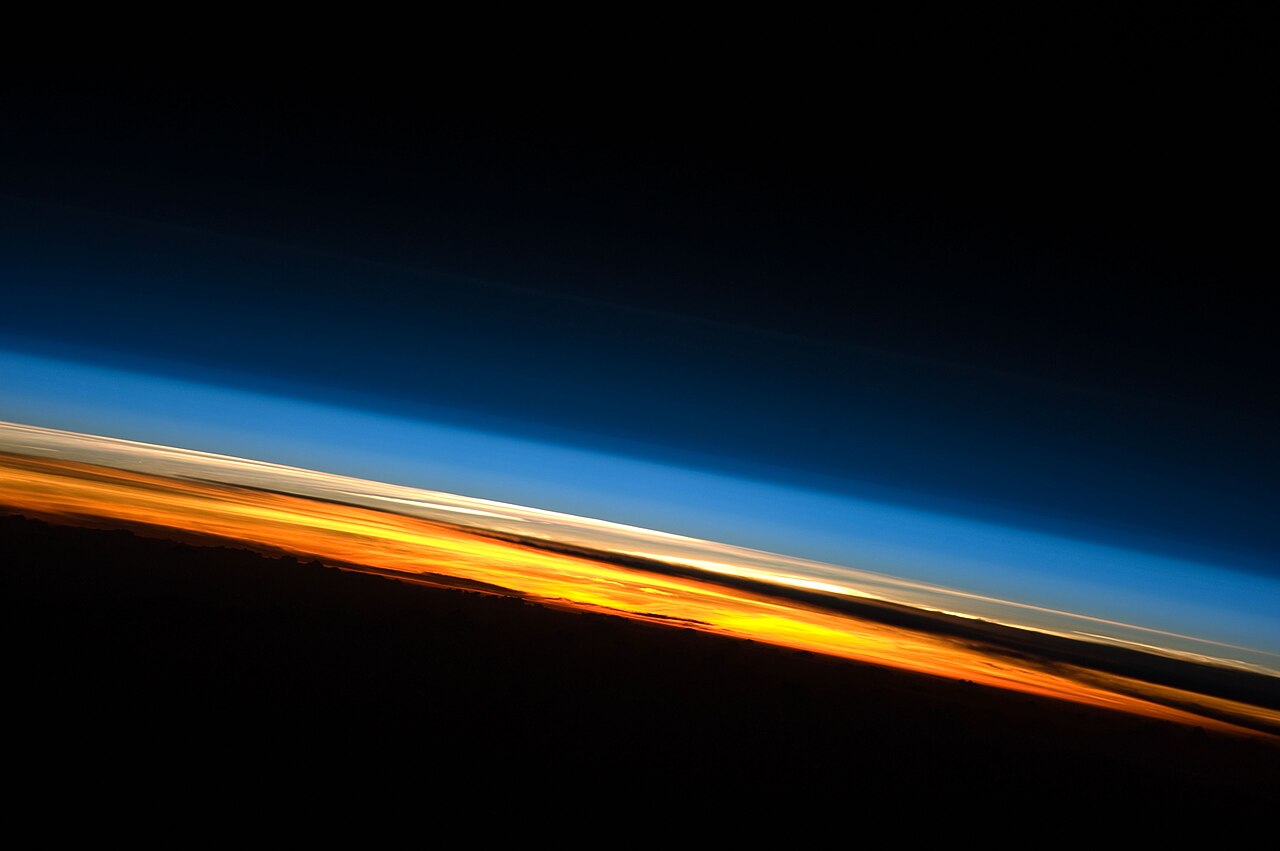
At sunrise and sunset the Sun is low in the sky, so its light passes through a thicker layer of atmosphere. The blue light is scattered further along that longer path, leaving the longer wavelengths, the reds and oranges, that give sunsets and sunrises their colours.
NASA says the western sky sometimes seems to glow red because small particles of dust, pollution or other aerosols also scatter blue light, leaving more purely red and yellow light to go through the atmosphere.
In a separate article on weather sayings, the Met Office says the old weather saying about a red sky at night is most reliable when weather systems predominantly come from the west, as they do in the UK. It says a red sky at night means fair weather is generally headed towards you.
Whether a sky is blue depends on what is in the atmosphere, NASA says. Mars has a very thin atmosphere made mostly of carbon dioxide and filled with fine dust particles. Photographs from NASA’s rovers and landers show an orange or reddish daytime sky there that takes on a blue-grey tone around the Sun at sunset, the opposite of what people experience on Earth.