A rainbow is sunlight bent and reflected inside raindrops
NOAA’s satellite agency says the outer bow of a double rainbow sends light out of the raindrop at 50° instead of the 42° of the red primary bow, which places it above the main bow.
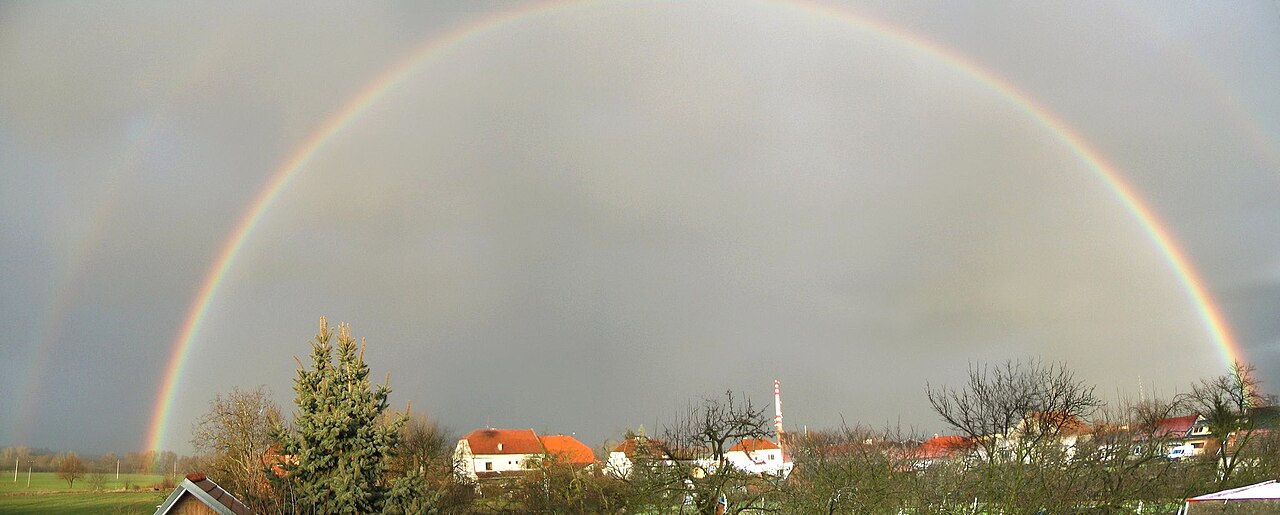
A rainbow is created through the refraction and reflection of sunlight in water droplets, the Met Office says.
When sunlight passes through a raindrop it slows down and bends, splitting into its component colours. Some of the light reflects off the inside surface of the droplet, then exits and bends again, sending a spectrum of colours toward the observer. For a rainbow to appear, the Sun must be behind you and water droplets in front.
A rainbow is not really a thing, NOAA’s satellite agency, NESDIS, says, and it does not exist in a particular place. It is an optical phenomenon that appears when sunlight and atmospheric conditions are just right and the viewer’s position is just right to see it.
Where the colours come from
Sunlight is made up of many wavelengths, NESDIS says, and some bend more than others on entering the droplet. Violet, the shortest visible wavelength, bends the most and red, the longest, bends the least, so the light leaves the droplet separated into its colours. The Met Office gives the classic order as red, orange, yellow, green, blue, indigo and violet. It adds that a rainbow actually contains a continuous range of hues, far more than the human eye can distinguish, and that Isaac Newton popularised the idea of seven distinct colours.
Why it is an arc
A full rainbow is actually a complete circle, NESDIS says, but from the ground people see only part of it. The Met Office says the ground usually blocks the lower half, and that from a mountain, a tall building or an aircraft a full circle can sometimes be seen.
Double rainbows and fogbows
A secondary bow appears when sunlight is reflected twice inside the droplets. That second reflection makes the light exit the drop at a different angle, NESDIS says: 50° instead of 42° for the red primary bow. This is why the secondary bow appears above the primary one. Its colours are reversed, with red on the bottom, and it is fainter because some light is lost at each reflection.
The Met Office says the area between the two bows, known as Alexander’s band, appears darker because no sunlight is scattered toward the observer there.
Fogbows, or ‘white rainbows’, form in fog, mist or cloud, the Met Office says. Their droplets are much smaller than raindrops, which makes the light diffract and smear out the colours, so fogbows look pale or nearly colourless and are broader than typical rainbows.